.png)

Tjörn Runt Regatta aboard the Bavaria Cruiser 40S by Keith Carew
Last Thursday our president Patrick Shaughnessy and I arrived in Gothenburg Sweden to race on the Bavaria Cruiser 40 Sport in the famous Tjörn Runt regatta. We designed this boat as a modification to the very popular Bavaria Cruiser 40. The design Brief was to incrementally improve the performance of the Cruiser 40 and add some features that make it more suited to racing. compared to the cruiser 40, the boat is 600kg lighter with a keel 30cm deeper and a rig that is 44cm taller. Our boat featured a jib in a tuff luff extrusion and Elvstrom Sails EPEX main and jib.
This particular 40s is owned by the Bavaria factory and is the same boat we raced earlier this year in Croatia at the Kornati Cup. At that race we finished second overall in a fleet of 102 behind the well sailed Bavaria Cruiser 40s owned by Pitter Yacht sales. The factory owns this boat to promote the 40s but also to show customers the sporting potential of the rest of the fleet of Cruisers of which we have designed all the current fleet of six.
Onboard were Bavaria's product manager Daniel Kohl, consultant Peter Meyer and journalist Marcus Schlichting. We also were fortunate to be joined by some notable locals. Magnus Olsson of Swedish yachting fame and two of his friends joined us and added a lot of local expertise as well as sailing skill and enthusiasm. Anyone who has sailed with Magnus knows the enthusiasm and good humor he brings to the effort -- on and off the boat.
The Tjörn Runt regatta has been sailed continuously since 1964. This year 332 boats participated in this 28 nautical mile race around the island of Tjörn. You may have seen YouTube videos of yachts piling up on rocks through narrow passages in Sweden. Most likely you were seeing the results of the battle to sail the shortest distance from start to finish as there are few restrictions for navigators besides the depth of your keel and your bravery.

We practiced on Friday, tuning the rig and ironing out a few wrinkles that have crept in since our April showing in Croatia. The weather was grey with light rain and light wind. But we were focusing on the next day's predicted sun and breeze. Saturday we awoke to clear skies and bright sun to start in 8-10 knots of breeze.
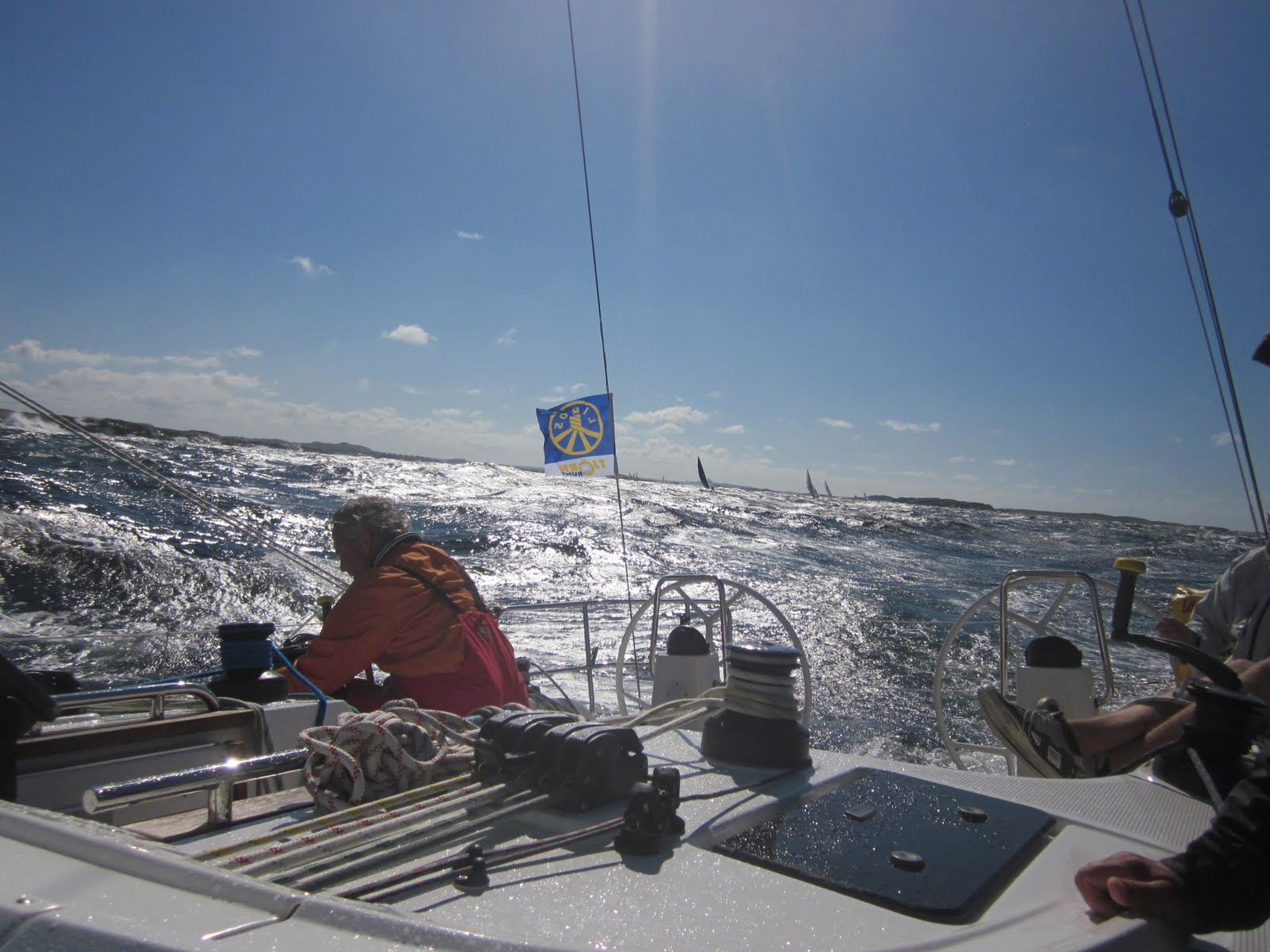
The breeze built as we beat along the fjord until we entered the North Sea in 25 knots and still building. We put in a reef to settle the boat and kept pushing hard. At this stage the navigators earn their keep. Our navigator Juppa has sailed this race many times but never in this boat so we sailed a conservative course and never had an incident. We did watch a competitor in an ILC 40 hit hard aground at 10 knots so we knew well what we were trying to avoid. As we sailed up the coast the wind built to as much as 35 knots with 2m swells. One feature of this event is the enormous spectator enthusiasm as evidenced by crowds lining the cliffs all along and announcers commenting on the crew and position of the various boats.
The last 8 miles were sailed in 20-25 knots dead downwind. Having shaken out the reef and set the kite, we quickly ran away from the boats around us and only one broach later had finished. As it turns out we were 6th in our class of 35 and 29th over all. With some very competitive crews ahead of us including the current European IRC champion, we felt pretty good about ourselves.
With the gorgeous venue of cliffs and big breeze and friendly crew and competitors, this will remembered as one of my favorite sailing events. I'm looking forward to doing better at this one next year as the Bavaria 40s continues its promotional activities around Europe.


1 comments:
Post a Comment